

Challenges
Challenges
1. Requirement for Balanced Performance and Expenditure
As the workloads directly impacted end-user services, the customer required an infrastructure solution that could lower operational spending while maintaining or improving system responsiveness, stability, and service quality.
2. Need for Technology Stack Flexibility
The customer aimed to eliminate dependency on proprietary cloud services and adopt open-source or cloud-native alternatives to enable greater portability, maintainability, and vendor neutrality.
3. Time-Sensitive Migration Timeline
With increasing costs and contractual deadlines approaching, the migration needed to be executed within a compressed timeline, requiring careful coordination to meet both technical and business expectations.
4. Strict Downtime Constraints
Given the real-time nature of the customer’s operations, downtime during migration had to be kept to an absolute minimum to avoid disruption to end-user services and business continuity.
5. Unstructured Project and Resource Governance
Several applications were hosted within a single project environment, leading to challenges in resource isolation, operational clarity, and cost accountability across business units.
Why Huawei Cloud?
Why Huawei Cloud?

High Value with Managed Expenditure
Huawei Cloud offers flexible pricing, resource-level transparency, and intelligent management tools that help customers reduce unnecessary spending while sustaining high performance for critical workloads.

High Performance with Enterprise-Grade Infrastructure
Huawei Cloud delivers robust computing, networking, and storage capabilities, ensuring low-latency and high-throughput performance suitable for real-time applications and mission-critical workloads.

High Agility with Open and Future-Proof Architecture
Huawei Cloud supports open-source technologies and industry-standard APIs, enabling customers to build scalable, portable systems without vendor lock-in, future-ready and aligned with long-term IT strategies.

High Reliability with Local Support and Migration Expertise
Huawei Cloud provides dedicated local technical support and end-to-end migration assistance, ensuring a smooth transition with minimal downtime and operational risk.
Solutions
Solutions
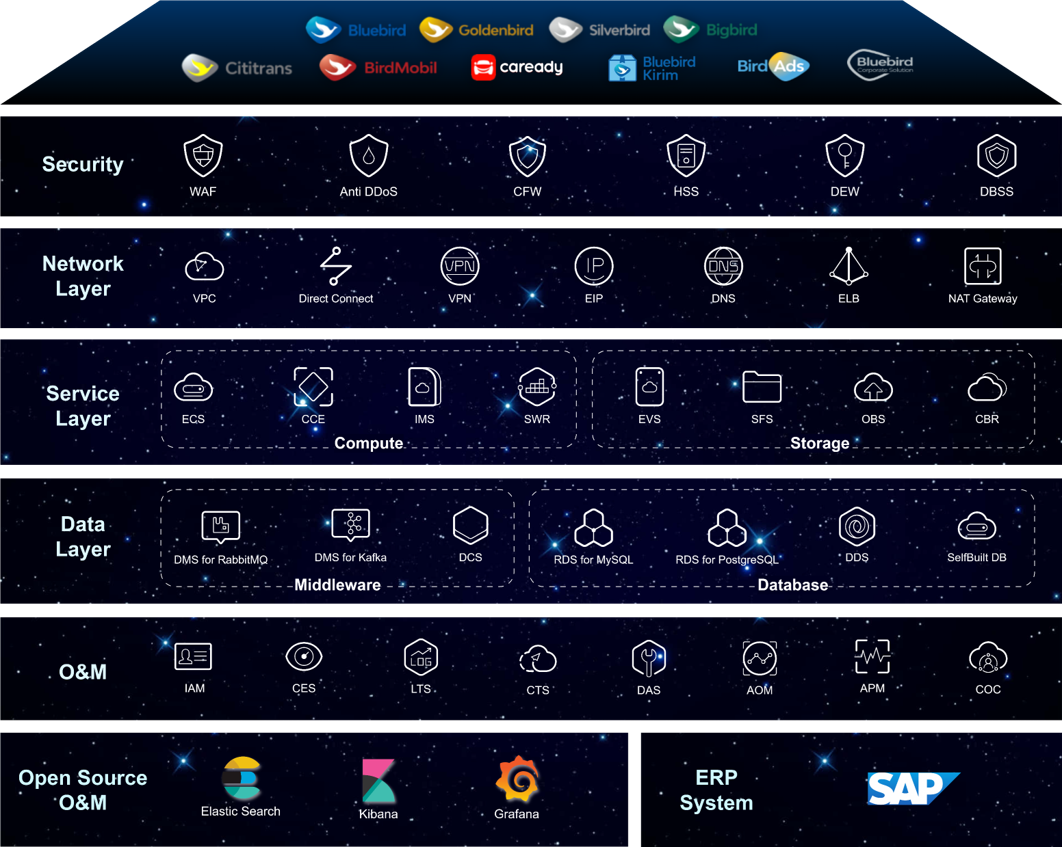
Customer Benefits
Customer Benefits

Reduced Operational Spending
Through precise resource allocation, well-structured architecture, and flexible pricing models, the customer successfully lowered ongoing cloud expenses while sustaining high service quality and performance

Enhanced Performance and Reliability
Migration resulted in measurable latency improvements:
• Fleetlist response time reduced and reached 40% faster.
• Partner order processing latency reduced and reached 50% faster.

Operational Flexibility and Scalability
Transition from proprietary queuing systems to open-source RabbitMQ, enabling easier integration, scalability, and vendor independence

Improved Security, Compliance, and Resilience
Robust multi-layer security safeguards business-critical applications and data, while Disaster Recovery (DRC) capabilities strengthen business continuity.
Reduced Operational Spending
Through precise resource allocation, well-structured architecture, and flexible pricing models, the customer successfully lowered ongoing cloud expenses while sustaining high service quality and performance
Enhanced Performance and Reliability
Migration resulted in measurable latency improvements:
• Fleetlist response time reduced and reached 40% faster.
• Partner order processing latency reduced and reached 50% faster.
Operational Flexibility and Scalability
Transition from proprietary queuing systems to open-source RabbitMQ, enabling easier integration, scalability, and vendor independence
Improved Security, Compliance, and Resilience
Robust multi-layer security safeguards business-critical applications and data, while Disaster Recovery (DRC) capabilities strengthen business continuity.
