

Huawei Cloud x Thai Ticket Major
Challenges
Challenges
Massive BOT Attacks Causing Service Disruption and Revenue Loss
During major concert and event ticket sales, the “Online Realtime Ticketing System” experienced peak traffic over 25 million packets per second, the highest request rate recorded historically, of which 80% were BOT-generated traffic. These malicious automated traffics were intended to flood login, booking requests and other vital services, aiming to block and secure large volumes of tickets for secondary market.
These malicious activities caused:
• The high BOT traffic overwhelmed the existing infrastructure, causing system slowdowns, timeouts, and temporary service unavailability.
• Genuine customers were unable to access the ticketing portal during critical sales windows, leading to reputation damage, social media backlash, and customer trust erosion.
• The company incurred direct revenue loss from incomplete transactions and indirect losses due to negative user experiences and reduced brand credibility. Also incur direct infrastructure costs to handle the extremely high traffic.
TTM urgently required a real-time, intelligent, and scalable protection mechanism to identify and block malicious traffic while ensuring a seamless experience for genuine users.
Why Huawei Cloud?
Why Huawei Cloud?

Enterprise-Grade Performance and Reliability
Huawei Cloud ensures ultra-low latency and 99.99% availability across Thailand’s multi–Availability Zones infrastructure. Its elastic architecture dynamically scales to handle traffic surges maintaining real-time responsiveness and stability during millions of concurrent transactions.

Advanced Security and Anti-BOT Protection
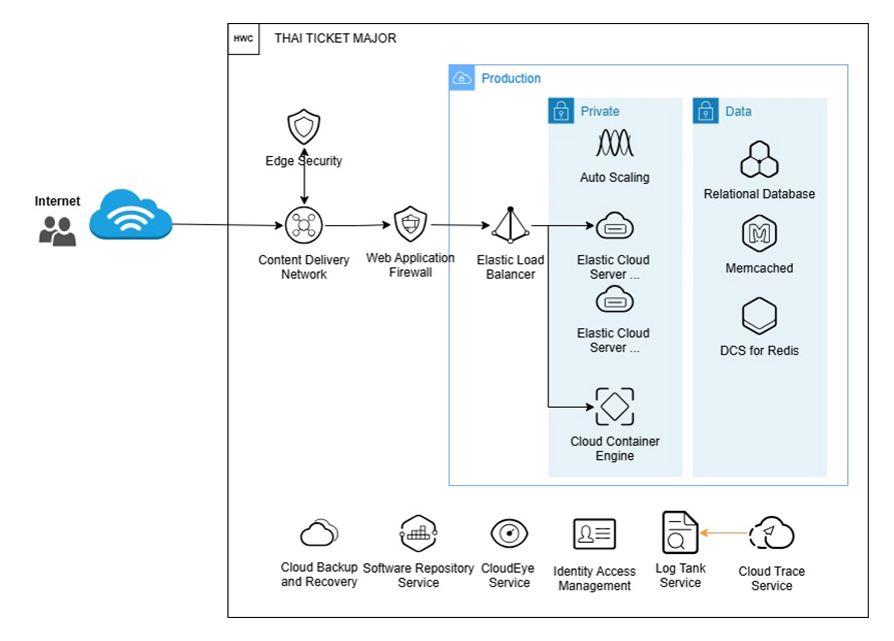
Huawei Cloud provides a multilayered security framework combining Edge Security, Anti-DDoS, Web Application Firewall (WAF), and Cloud Eye monitoring to protect against malicious attacks. AI-powered BOT detection can detect and block abnormal BOT activity in a few milliseconds, helping to maintain service integrity and fair ticket access for legitimate users. The platform complies with international and local standards such as ISO 27001 and Thailand's PDPA.

Localized Support and Global Innovation
Huawei Cloud combines local expertise in Thailand with global cloud innovation. Its local data centers ensure data sovereignty, low-latency access, and compliance with national regulations. Supported by Huawei’s global R&D capabilities, customers benefit from cutting-edge technologies AI, Big Data, and DevSecOps delivered through a locally managed service and 24/7 Thai-speaking technical support, ensuring both performance and trust for enterprise customers.
Solutions
Solutions
Customer Benefits
Customer Benefits

Guaranteed Service Availability During Peak Traffic
With Huawei Cloud’s integrated Anti-DDoS, CDN, Edge Security and WAF, TTM ensured uninterrupted operations throughout high-demand ticket sales events, successfully handling traffic peaks of up to 25 million packets per second (PPS). The system automatically absorbed and filtered abnormal traffic before it reached backend servers, ensuring that legitimate users could access the ticketing site without interruption. This resilience eliminated downtime during critical events, safeguarding both business continuity and customer trust while maximizing revenue opportunities during limited-time ticket sales.

Enhanced User Experience and Fair Ticket Access
By combining intelligent BOT detection with low-latency CDN acceleration, Huawei Cloud ensured faster, fairer, and more secure ticketing transactions. Genuine users experienced seamless access with reduced page load times, while automated scalping bots were blocked at the edge. The solution protected the integrity of TTM’s ticket distribution, promoted fairness among buyers, and strengthened public confidence in the brand’s digital platform, resulting in higher satisfaction and fewer complaints during high-demand sales.
Strengthened Security Governance and Operational Visibility
Huawei Cloud’s Cloud Eye, WAF analytics, and Security Center provided centralized visibility into security posture and real-time traffic monitoring. TTM’s IT team gained actionable insights into attack trends, traffic anomalies, and performance metrics through AI-powered dashboards. This enabled proactive defense tuning, faster incident response, and continuous improvement of security policies. The result was a more secure, well-governed ticketing platform that aligned with PDPA and cybersecurity best practices enhancing both operational efficiency and compliance assurance.
Guaranteed Service Availability During Peak Traffic
With Huawei Cloud’s integrated Anti-DDoS, CDN, Edge Security and WAF, TTM ensured uninterrupted operations throughout high-demand ticket sales events, successfully handling traffic peaks of up to 25 million packets per second (PPS). The system automatically absorbed and filtered abnormal traffic before it reached backend servers, ensuring that legitimate users could access the ticketing site without interruption. This resilience eliminated downtime during critical events, safeguarding both business continuity and customer trust while maximizing revenue opportunities during limited-time ticket sales.
Enhanced User Experience and Fair Ticket Access
By combining intelligent BOT detection with low-latency CDN acceleration, Huawei Cloud ensured faster, fairer, and more secure ticketing transactions. Genuine users experienced seamless access with reduced page load times, while automated scalping bots were blocked at the edge. The solution protected the integrity of TTM’s ticket distribution, promoted fairness among buyers, and strengthened public confidence in the brand’s digital platform, resulting in higher satisfaction and fewer complaints during high-demand sales.
Strengthened Security Governance and Operational Visibility
Huawei Cloud’s Cloud Eye, WAF analytics, and Security Center provided centralized visibility into security posture and real-time traffic monitoring. TTM’s IT team gained actionable insights into attack trends, traffic anomalies, and performance metrics through AI-powered dashboards. This enabled proactive defense tuning, faster incident response, and continuous improvement of security policies. The result was a more secure, well-governed ticketing platform that aligned with PDPA and cybersecurity best practices enhancing both operational efficiency and compliance assurance.