

Challenges
Challenges
1. High storage costs: WPS has a large number of users, and the documents and backup data they generate require a large amount of storage resources. Using a unified storage model for frequently accessed data and infrequently accessed archived data results in inefficient use of high-cost storage resources, leading to a steady increase in storage costs over the years.
2. Unstable connections to other IDCs through public networks: Public network connections have poor link stability, often resulting in high latency, packet loss, jitter, or even interruptions. This unstable network connection directly affects the transmission and synchronization of business data, causing slow response and lagging cross-IDC service interactions.
3. Poor service experience due to cross-region connectivity issues: To meet the access needs of users in different regions, WPS deploys services across multiple regions on Huawei Cloud. However, the existing architecture creates barriers between regions, leading to high latency and poor stability. This results in low efficiency in cross-region collaborative editing and data synchronization, negatively impacting the user experience for multi-region users and hindering the company's global business expansion.
Why Huawei Cloud?
Why Huawei Cloud?

Huawei Cloud’s OBS Intelligent Bucket Solution Reduces Storage Costs
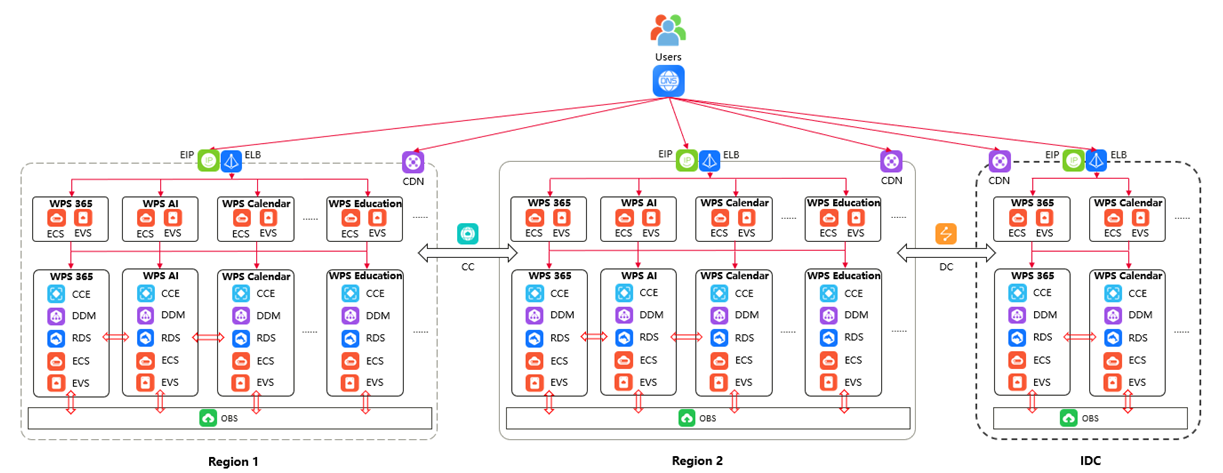
This solution optimizes storage resource utilization and reduces costs through intelligent tiered storage and automated lifecycle management. It automatically classifies data based on access frequency—frequently accessed, infrequently accessed, and archived storage—and assigns them to the appropriate storage tiers. This ensures fast access to frequently used data while lowering the storage cost of less frequently accessed and archived data. It also supports elastic scaling and a pay-as-you-use model, eliminating idle resources and further improving overall storage efficiency and cost effectiveness.

Huawei Cloud’s Direct Connect Solution Provides a Secure Dedicated Channel
This solution establishes a high-speed, stable, and secure dedicated channel between an enterprise's own computing environment and the Huawei Cloud user computing environment. WPS uses the Direct Connect access service to connect computers in the local data center to cloud servers or managed hosts on Huawei Cloud through a private network, achieving a secure and reliable hybrid cloud deployment.

Huawei Cloud’s Cloud Connect Solution Enables Efficient Interconnection between Nodes in Different Regions
This solution overcomes cross-region connectivity barriers by establishing high-speed private channels across Huawei Cloud regions, improving cross-region service experience. It leverages Huawei Cloud’s backbone network to enable low-latency private communication between regions and supports scenarios such as cross-region collaboration, data backup, and service expansion with bidirectional data synchronization and seamless service switching. It also allows flexible addition of interconnected nodes while reducing R&D and O&M costs to support efficient business growth.
Solutions
Solutions
Customer Benefits
Customer Benefits

Cost-efficient and Intelligent Data Storage
Huawei Cloud’s OBS Intelligent Bucket addresses the pain points of high storage costs, low resource utilization, and complex operations and maintenance for customers' massive data storage through intelligent tiered storage and automated lifecycle management. It can automatically identify hot data, warm data, and cold/archived data, and match them to Standard Storage, Infrequent Access Storage, and Archive Storage, respectively, without the need for manual intervention, ensuring more rational data storage. Additionally, it provides elastic scaling, high reliability, and fine-grained access control, significantly reducing the total cost of ownership while ensuring data security and access efficiency, making long-term storage of massive documents, backups, and archived data more economical and worry-free.

Secure and Stable Hybrid Cloud Connectivity
Huawei Cloud’s Direct Connect (DC) establishes a dedicated private channel between an on-premises data center (IDC) and Huawei Cloud, physically isolating the two and completely eliminating the issues of unstable public network access, high latency, packet loss, insecure data transmission, and poor hybrid cloud collaboration. Direct Connect provides high bandwidth, low latency, and stable, reliable connections, ensuring that data does not travel through the public network, thus avoiding network fluctuations and security risks, and achieving efficient cloud-network integration and hybrid cloud collaboration. Through Direct Connect, a stable connection can be established between the on-premises IDC and cloud services, ensuring real-time synchronization of core data and continuous business operations, meeting customers' high requirements for stability, security, and compliance.

Seamless Multi-region Network Interconnection
Huawei Cloud’s Cloud Connect (CC) creates an enterprise-level unified network that spans multiple regions, VPCs, and on-premises IDCs, addressing the challenges of isolated regions, difficult cross-region communication, complex network topologies, high O&M costs, and poor collaboration experience for customers. CC enables seamless one-hop access within each region of the cloud, with automated networking and simplified configuration, and supports cross-region interconnection in just minutes, significantly reducing latency and packet loss. With CC, customers can achieve distributed deployment of global or national services, efficient data flow, multi-site collaboration, and disaster recovery, making cross-region operations, multi-node services, and global applications more stable, efficient, and easier to manage.
Cost-efficient and Intelligent Data Storage
Huawei Cloud’s OBS Intelligent Bucket addresses the pain points of high storage costs, low resource utilization, and complex operations and maintenance for customers' massive data storage through intelligent tiered storage and automated lifecycle management. It can automatically identify hot data, warm data, and cold/archived data, and match them to Standard Storage, Infrequent Access Storage, and Archive Storage, respectively, without the need for manual intervention, ensuring more rational data storage. Additionally, it provides elastic scaling, high reliability, and fine-grained access control, significantly reducing the total cost of ownership while ensuring data security and access efficiency, making long-term storage of massive documents, backups, and archived data more economical and worry-free.
Secure and Stable Hybrid Cloud Connectivity
Huawei Cloud’s Direct Connect (DC) establishes a dedicated private channel between an on-premises data center (IDC) and Huawei Cloud, physically isolating the two and completely eliminating the issues of unstable public network access, high latency, packet loss, insecure data transmission, and poor hybrid cloud collaboration. Direct Connect provides high bandwidth, low latency, and stable, reliable connections, ensuring that data does not travel through the public network, thus avoiding network fluctuations and security risks, and achieving efficient cloud-network integration and hybrid cloud collaboration. Through Direct Connect, a stable connection can be established between the on-premises IDC and cloud services, ensuring real-time synchronization of core data and continuous business operations, meeting customers' high requirements for stability, security, and compliance.
Seamless Multi-region Network Interconnection
Huawei Cloud’s Cloud Connect (CC) creates an enterprise-level unified network that spans multiple regions, VPCs, and on-premises IDCs, addressing the challenges of isolated regions, difficult cross-region communication, complex network topologies, high O&M costs, and poor collaboration experience for customers. CC enables seamless one-hop access within each region of the cloud, with automated networking and simplified configuration, and supports cross-region interconnection in just minutes, significantly reducing latency and packet loss. With CC, customers can achieve distributed deployment of global or national services, efficient data flow, multi-site collaboration, and disaster recovery, making cross-region operations, multi-node services, and global applications more stable, efficient, and easier to manage.