Industry Trends

Hybrid Cloud Disaster Recovery and Backup Development Trends

Hybrid Cloud Disaster Recovery and Backup Development Trends

With the rapid development of the cloud computing industry and ever-increasing customer needs, the IT infrastructure at organizations of all sizes are placing more and more services into a cloud framework. This move presents enterprises with some daunting challenges in ensuring service continuity.


Enterprises are choosing cloud services because they are cheaper, able to eliminate environment bottlenecks, and able to fully gear into ever-changing developments to suit the growth strategies of the enterprises. For service systems, security and stability are always the top priority. Traditional geo-redundant DR models often comprising two sites and three data centers in a single cloud ensure rapid restoration for services during downed events at one or even multiple locations. However, these types of models cannot be used to handle service interruptions caused by system errors. Therefore, the multi-cloud backup and on-cloud DR models will become the focus in the cloud computing context to ensure zero service interruptions.


Enterprises use multi-cloud solutions for various reasons. The data requirements as well as data protection and management strategies of an enterprise determine whether multi-cloud and cross-cloud DR capabilities are required. For example, if the enterprise data management strategy emphasizes multiple backups, then the multi-cloud strategy is the correct choice. According to research from Enterprise Management Associates (EMA), 61% of the enterprises with services running in clouds use at least two clouds.

    Business Challenges

    • High Costs in DR Center Builds and O&M

      To build a traditional DR center, enterprises need to build or rent equipment rooms and invest lots of manpower in maintenance and testing. Accomplishing a full DR mode incurs high CAPEX and OPEX as the arms of both or multiple centers must reach the same scale and achieve near real-time transmission.

      To build a traditional DR center, enterprises need to build or rent equipment rooms and invest lots of manpower in maintenance and testing. Accomplishing a full DR mode incurs high CAPEX and OPEX as the arms of both or multiple centers must reach the same scale and achieve near real-time transmission.

    • Many Restrictions on DR Drills

      If a DR drill is performed in a traditional DR center, equipment rooms and cables need to be scheduled, and some cold standby devices need to be powered on, which causes a high fault rate. Switchovers may delay or even fail at the critical moment in spite of the drills, leaving the enterprise vulnerable with weak service recovery capabilities.

      If a DR drill is performed in a traditional DR center, equipment rooms and cables need to be scheduled, and some cold standby devices need to be powered on, which causes a high fault rate. Switchovers may delay or even fail at the critical moment in spite of the drills, leaving the enterprise vulnerable with weak service recovery capabilities.

    • Complicated Data Synchronization Policies

      The synchronization policies for hosts, databases, and storage devices are complicated and restricted by the transmission distance and data volume. In addition, the data encryption/decryption mechanism complicates deployments and maintenance. As a result, some data becomes invalid, or the system cannot meet the designed RPO.

      The synchronization policies for hosts, databases, and storage devices are complicated and restricted by the transmission distance and data volume. In addition, the data encryption/decryption mechanism complicates deployments and maintenance. As a result, some data becomes invalid, or the system cannot meet the designed RPO.

    • Architecture Difficult to Implement

      Core services require multi-center architectures to ensure service continuity, requiring large amounts of investment and extensive consideration in design as to how all the parts of the architecture will collaborate. Implementing this architecture with a traditional DR model equates to high costs and the benefits are limited.

      Core services require multi-center architectures to ensure service continuity, requiring large amounts of investment and extensive consideration in design as to how all the parts of the architecture will collaborate. Implementing this architecture with a traditional DR model equates to high costs and the benefits are limited.

    Typical Scenarios

    Introduction

    Cost-Effective and Secure Enterprise Backup Solution

    Benefits

    • Economical and Efficient Backup

      Storage resources are billed by usage. Upfront investments are reduced by 20% to 80%. Data is transmitted after deduplication and compression, saving you big on storage costs while shortening the backup window often by as much as 75%.

    • Secure and Reliable Data Transmission and Backup

      Data is encrypted throughout the entire process: at the source end, during transmission, and in OBS. Data durability reaches 99.99999%.

    Related Services

    Introduction

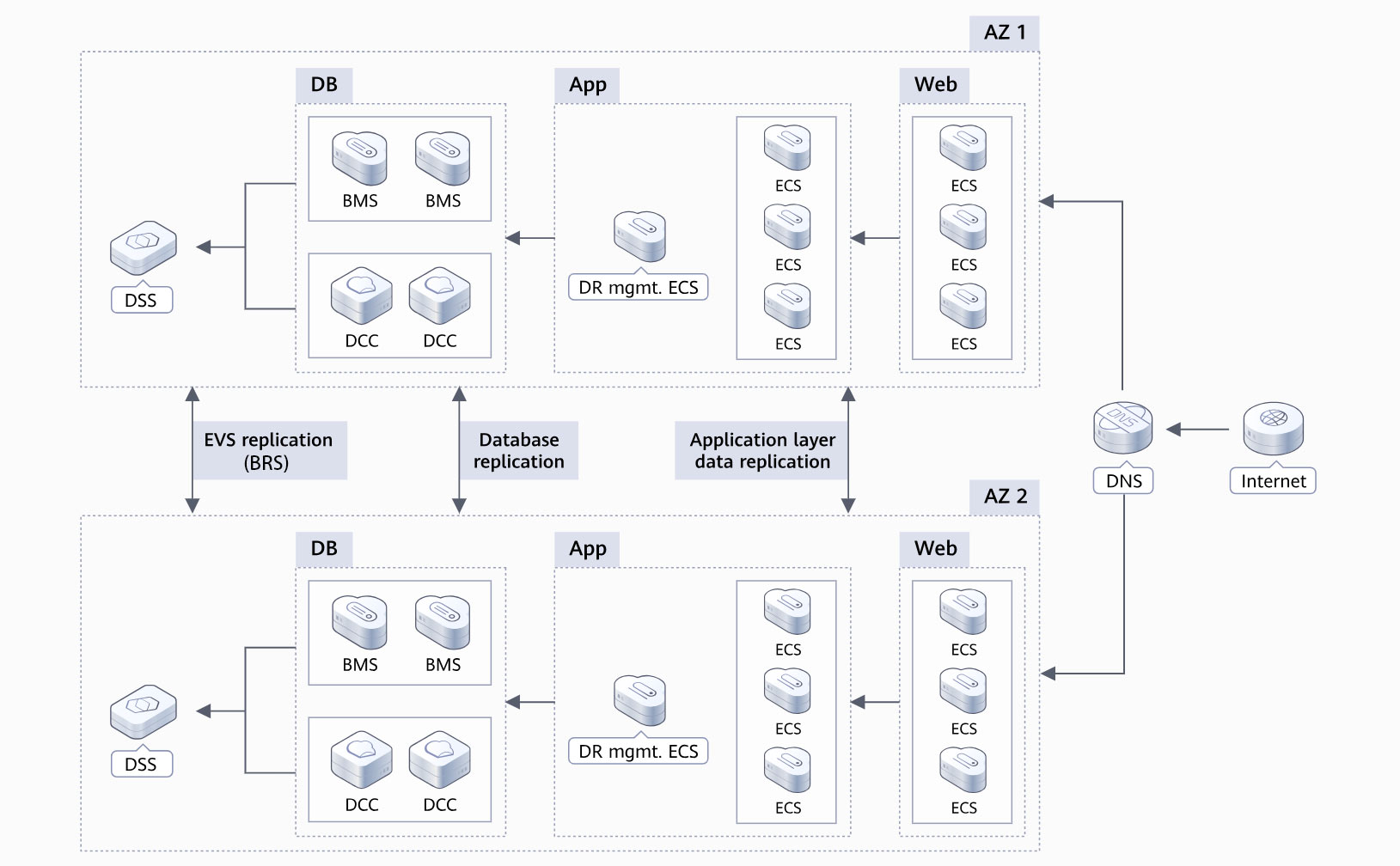
    HA Public Cloud DR Center

    Benefits

    • New IoT Connection Processing Module

    • Selects the optimal replication technology for the layers and other particulars in your profile:

      Application layer: multi-cloud architecture and multi-cloud connections switchover

      Virtualization layer: data synchronization supported by the ecosystem cooperation solution

      Database layer: replication software of mainstream databases, such as Oracle and MySQL

      Storage layer: asynchronous replication of Huawei storage arrays to HUAWEI CLOUD Dedicated Enterprise Storage Service (DESS)

    Related Services

    Introduction

    Intra-City DR Capability with RPO =0

    Benefits

    • Enterprise-level DR-as-a-Service

    • High reliability

      Provides VM-level DR protection across AZs (RPO =0) and hour-level RTO to meet tier-5 DR standards. Quickly recover services if the production site goes down, minimizing service interruptions and helping eliminate data loss.

    • Low cost

      Reduces the enterprise DR TCO and simplifies the DR process.

    Related Services

    Recommended Configurations

    VM On-Cloud DR
    Service VMs 100
    Data Quantity 50 TB
    Product
    Specifications
    E-waybill recognition
    10 million/year package
    --
    --
    Certificate recognition
    100,000/year package
    --
    --
    Image recognition
    200,000/year package
    --
    --
    ECS
    4U8G | 4 units
    --
    --
    OBS
    10 TB/year
    --
    --
    General-purpose enhanced MySQL
    2U4G | 2 units
    --
    --

    App On-Cloud DR

    Service VMs 100
    Data Quantity 50 TB
    Product
    Specifications
    ECS (DR VM)
    Same as computing resources of production VMs| 100
    --
    --
    ECS (DR mgmt. system)
    8 vCPUs | 16 GB memory | 500 GB Ultra-High I/O disk | 12
    --
    --
    EVS
    Same as storage resources of production VMs| 50 TB
    --
    --
    Direct Connect
    200 Mbit/s
    --
    --
    VPN (optional)
    Pay per usage (time-based)
    --
    --
    Anti-DDoS
    Free
    --
    --
    WAF
    Pay per bandwidth unit and usage (time-based)
    --
    --
    App On-Cloud DR (DeC)
    Service VMs 200
    Data Quantity 100 TB
    Product
    Specifications
    BMS
    Determined by physical hosts in the production center| 8
    --
    --
    DCC
    Determined by the CPU/memory ratio of the production center | 12
    --
    --
    DSS
    Ultra High I/O | 1
    --
    --
    DSS
    High I/O| 1
    --
    --
    Direct Connect (optional)
    400 Mbit/s
    --
    --
    VPN (optional)
    Pay per usage (time-based)
    --
    --
    Anti-DDoS
    Free
    --
    --
    WAF
    Pay per bandwidth unit and usage (time-based)
    --
    --
    On-Cloud DR
    Service Hosts 100
    Data Quantity 50 TB
    Product
    Specifications
    SDRS
    Determined by service requirements
    --
    --
    ECS (DR VM)
    Same as computing resources of production VMs | 100
    --
    --
    EVS
    Same as storage resources of production VMs | 50 TB
    --
    --
    VPN (optional)
    Pay per usage (time-based)
    --
    --
    Anti-DDoS
    Free
    --
    --
    WAF
    Pay per bandwidth unit and usage (time-based)
    --
    --
    On-Cloud DR (DeC)
    Service Hosts 200
    Data Quantity 100 TB
    Product
    Specifications
    SDRS
    Pay per number of DR VMs
    --
    --
    BMS
    Pay per number of BMSs
    --
    --
    DCC
    Determined by the CPU/memory ratio of the production center | 12
    --
    --
    DSS
    Ultra High I/O | 2
    --
    --
    VPN (optional)
    Pay per usage (time-based)
    --
    --
    Anti-DDoS
    Free
    --
    --
    WAF
    Pay per bandwidth unit and usage (time-based)
    --
    --
    CBH
    4 vCPUs | 8 GB memory | 400 GB hard disk | 2
    --
    --
    VM
    VM On-Cloud DR
    Service VMs 100
    Data Quantity 50 TB
    E-waybill recognition
    Specifications:
    10 million/year package
    :
    :
    Certificate recognition
    Specifications:
    100,000/year package
    :
    :
    Image recognition
    Specifications:
    200,000/year package
    :
    :
    ECS
    Specifications:
    4U8G | 4 units
    :
    :
    OBS
    Specifications:
    10 TB/year
    :
    :
    General-purpose enhanced MySQL
    Specifications:
    2U4G | 2 units
    :
    :
    App

    App On-Cloud DR

    Service VMs 100
    Data Quantity 50 TB
    ECS (DR VM)
    Specifications:
    Same as computing resources of production VMs| 100
    :
    :
    ECS (DR mgmt. system)
    Specifications:
    8 vCPUs | 16 GB memory | 500 GB Ultra-High I/O disk | 12
    :
    :
    EVS
    Specifications:
    Same as storage resources of production VMs| 50 TB
    :
    :
    Direct Connect
    Specifications:
    200 Mbit/s
    :
    :
    VPN (optional)
    Specifications:
    Pay per usage (time-based)
    :
    :
    Anti-DDoS
    Specifications:
    Free
    :
    :
    WAF
    Specifications:
    Pay per bandwidth unit and usage (time-based)
    :
    :
    App (DeC)
    App On-Cloud DR (DeC)
    Service VMs 200
    Data Quantity 100 TB
    BMS
    Specifications:
    Determined by physical hosts in the production center| 8
    :
    :
    DCC
    Specifications:
    Determined by the CPU/memory ratio of the production center | 12
    :
    :
    DSS
    Specifications:
    Ultra High I/O | 1
    :
    :
    DSS
    Specifications:
    High I/O| 1
    :
    :
    Direct Connect (optional)
    Specifications:
    400 Mbit/s
    :
    :
    VPN (optional)
    Specifications:
    Pay per usage (time-based)
    :
    :
    Anti-DDoS
    Specifications:
    Free
    :
    :
    WAF
    Specifications:
    Pay per bandwidth unit and usage (time-based)
    :
    :
    On
    On-Cloud DR
    Service Hosts 100
    Data Quantity 50 TB
    SDRS
    Specifications:
    Determined by service requirements
    :
    :
    ECS (DR VM)
    Specifications:
    Same as computing resources of production VMs | 100
    :
    :
    EVS
    Specifications:
    Same as storage resources of production VMs | 50 TB
    :
    :
    VPN (optional)
    Specifications:
    Pay per usage (time-based)
    :
    :
    Anti-DDoS
    Specifications:
    Free
    :
    :
    WAF
    Specifications:
    Pay per bandwidth unit and usage (time-based)
    :
    :
    On (DeC)
    On-Cloud DR (DeC)
    Service Hosts 200
    Data Quantity 100 TB
    SDRS
    Specifications:
    Pay per number of DR VMs
    :
    :
    BMS
    Specifications:
    Pay per number of BMSs
    :
    :
    DCC
    Specifications:
    Determined by the CPU/memory ratio of the production center | 12
    :
    :
    DSS
    Specifications:
    Ultra High I/O | 2
    :
    :
    VPN (optional)
    Specifications:
    Pay per usage (time-based)
    :
    :
    Anti-DDoS
    Specifications:
    Free
    :
    :
    WAF
    Specifications:
    Pay per bandwidth unit and usage (time-based)
    :
    :
    CBH
    Specifications:
    4 vCPUs | 8 GB memory | 400 GB hard disk | 2
    :
    :

    Partners